
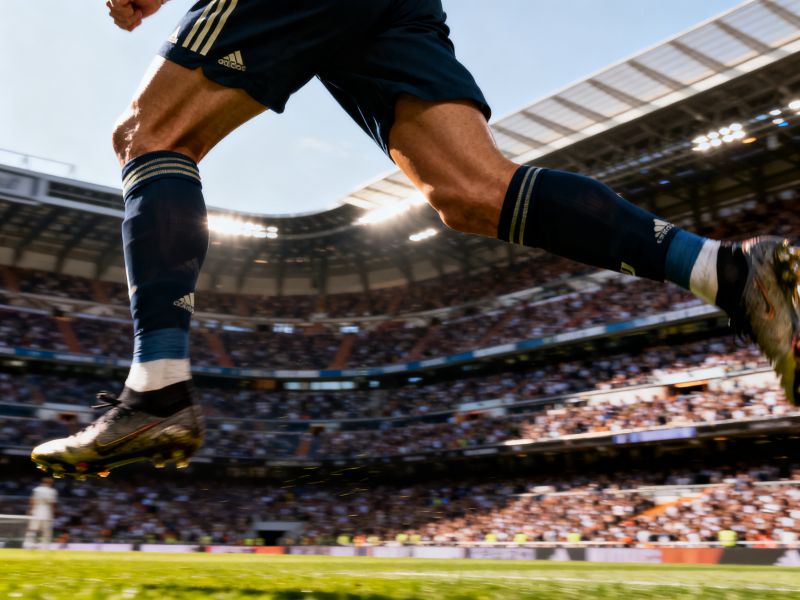
tanding at 6'2" and weighing around 85 kilograms, Cristiano Ronaldo carries a physique that feels almost engineered for football. His body fat hovers near 7%, a figure more typical of a sprinter than a footballer. During the 2018 Champions League final, cameras caught him flexing after a goal—the definition in his quadriceps was so sharp it looked like an anatomy chart. That's not vanity;it's a survival tool in a sport where milliseconds and millimeters decide careers.What separates Ronaldo's muscles from those of other elite athletes is the balance between explosive power and endurance. His legs, particularly the quadriceps and glutes, generate extraordinary sprint speed—he has clocked runs over 33 km/h even in his late thirties. Yet he also covers 10-11 kilometers per match, often with repeated high-intensity bursts. A 2020 study on elite footballers noted that Ronaldo's lower-body muscle composition shows a higher proportion of fast-twitch fibers。
which explains his acceleration. But here's the thing: fast-twitch fibers fatigue quickly. Ronaldo's edge comes from how he trains them—plyometrics, resistance work, and recovery protocols that border on obsessive.His upper body gets less attention, but it matters. The chest and shoulders he has built provide shielding in duels and power in aerial challenges. I remember a 2016 match against Atletico Madrid where he outjumped a defender by nearly a foot, heading the ball with a neck-cranking snap. That leap required core stability and shoulder strength, not just leg drive. His abdominal muscles, visible even through a jersey。act as a transfer point between lower and upper body force. Without that core, his famous bicycle kick against Juventus in 2018—where his body was almost parallel to the ground—would have been physically impossible.Critics sometimes argue that Ronaldo's muscle mass might hinder agility. The evidence says otherwise. His change-of-direction speed remains elite because muscle size isn't the goal;functional strength is. He doesn't train for beach muscles. His routines emphasize unilateral movements, balance, and flexibility—think single-leg deadlifts and resisted sprints rather than bicep curls. You see the result in how he absorbs contact: he rarely goes to ground easily。and when he does, he bounces back up. That resilience is built into the muscle fiber itself.
Ronaldo's muscles are a case study in specificity. They serve a single purpose: to keep him competitive at the highest level for two decades. You can't copy his genetics, but you can copy his discipline. The muscles aren't the story—the work behind them is.